How Does ChatGPT Decide Which Businesses to Recommend?
For anything current or local, ChatGPT almost never answers from memory — it runs a live search, pulls a handful of pages, and pieces together an answer from what those pages say.
On this page9 sections
- Two different things are happening, and people mix them up
- How the live-search version actually works, step by step
- What live AI search is actually reading
- What I don't think matters much (yet)
- What not to do
- What actually seems to move the needle
- A real example: from Google traffic to AI visibility
- Frequently asked questions
- The honest summary
Short answer: For anything current or local, ChatGPT almost never answers from memory — it runs a live search, pulls a handful of pages, and pieces together an answer from what those pages say. Businesses that get mentioned tend to have three things in common: their basic facts (name, service area, hours, services) are readable by machines through schema markup, those same facts are repeated consistently across their website, Google Business Profile, and a few independent sources, and their site doesn't accidentally block the AI crawlers doing the reading. Nobody outside OpenAI, Anthropic, or Google knows the full ranking logic, and this article won't pretend otherwise — but that pattern holds up consistently across real sites.
A few weeks ago I wrote about asking ChatGPT to recommend my own business and getting nothing back. That post was about what happened. This one is about why it happened — what's actually going on when an AI model decides one business is worth mentioning and another isn't, and what you can actually do about it this month, not in some vague future.
I'm not going to pretend I have this fully figured out. Anyone who tells you they've "cracked the algorithm" is selling something. What follows is what I've seen work across real client sites, cross-checked against what these companies have said publicly about how their models retrieve information — and I've tried to be specific about where I'm confident versus where I'm guessing.
Two different things are happening, and people mix them up
When someone asks ChatGPT "who's a good plumber in Austin," one of two things happens:
- The model answers from training data — patterns it learned during training, with no live lookup. This is static and slow to change; it reflects how visible your business was across the web as of the training cutoff, and it updates only when a new model version is trained.
- The model does a live search — ChatGPT with browsing, Perplexity, Google's AI Overviews, and similar tools actually query the web in real time, pull a handful of pages, and summarize them.
Most business owners assume it's #1 — that ChatGPT "just knows" things, like a search engine with opinions. In practice, for anything even slightly current or local, it's almost always #2 now. ChatGPT's browsing mode, Perplexity by default, and Google's AI Overviews are all doing live retrieval for local and "best X near me" style questions — they're not relying on frozen training data for anything time-sensitive.
That distinction matters because it changes where your effort should go. If it were mostly #1, the only lever you'd have would be waiting for the next model to be trained on a more visible version of the internet — which is slow and mostly out of your hands. Because it's mostly #2, your actual website, today, is part of what gets read on every single query. That's a lever you control directly, and it's the whole point of this article.
How the live-search version actually works, step by step
It helps to walk through what happens between someone typing a question and getting an answer, because each step is a place where a business can either show up or get skipped:
- The model rewrites the question into search queries. "Who's a good plumber in Austin" might become two or three actual searches — something close to what you'd type into Google yourself.
- It retrieves a short list of pages — usually somewhere in the range of five to ten sources, not the full first page of search results.
- It skims each page for extractable facts, not the full text. This is closer to how a person scans a page in three seconds than how a person actually reads it.
- It cross-checks facts across sources. If your GBP says one service area and your website says another, that inconsistency doesn't help — at best it gets ignored, at worst it makes the model less confident about mentioning you at all.
- It writes the answer, usually citing two or three sources, sometimes with a link, sometimes without.
Every one of those five steps is a place your site can either help or actively work against itself.
What live AI search is actually reading
When the model does a live lookup, it's not reading your website the way a human does. It's pulling a small number of sources, often 5–10, and trying to extract clean facts fast. A few things consistently make that easier:
Structured data (schema markup). LocalBusiness, Service, Review, and FAQPage schema give the model machine-readable facts instead of forcing it to infer things from paragraphs. This is the single most concrete lever a business actually controls, and it's the one most small business sites get wrong or skip entirely.
Third-party confirmation, not just your own claims. A model has no reason to trust "we're the best plumbers in Austin" written on your own homepage. It has more reason to trust the same claim if it also shows up on your Google Business Profile, in a review site, in a local news mention, or on an industry directory. This is basically E-E-A-T for machines — consistent facts repeated across independent sources.
Whether AI crawlers can even reach your site at all. This sounds basic, but it's the one that surprised me the most. We wrote about a real case where a client's robots.txt was silently blocking GPTBot and ClaudeBot — the content was fine, the SEO was fine, but the site was invisible to AI crawlers because of three lines in a config file nobody had looked at in years. If you haven't checked this, it's worth five minutes before anything else on this list.
Recency signals. Reviews, GBP posts, and blog activity from the last few months seem to carry more weight than a static "About Us" page from 2019. Live search tools appear to weight freshness the way Google does, maybe more.
What I don't think matters much (yet)
This is where I'll give an honest opinion instead of hedging, because vague "it depends" answers aren't useful to anyone.
- Backlink volume for its own sake. In classic SEO, more links usually helps. For AI visibility, I haven't seen evidence that raw link count matters the way it does for Google rankings. What seems to matter more is whether a small number of trusted, topically relevant sources mention you — a local news write-up beats twenty low-quality directory links.
- Paid ads. ChatGPT and Perplexity aren't pulling from your Google Ads campaigns. This is one of the clearest gaps between traditional marketing spend and AI visibility, and it's part of why smaller businesses can actually compete here — money alone doesn't buy a mention.
- Keyword density. Stuffing "best plumber in Austin" fifteen times into a page doesn't help a language model the way it might have helped 2012-era Google. These models are reading for meaning, not counting occurrences.
I could be wrong about some of this in six months — this space moves fast, and I'd rather say what I currently believe and be corrected than give you a mushy non-answer.
What not to do
Since we're being honest: there are a few things being sold right now as "AI SEO" that I don't think work, and I'm not going to pretend otherwise just because it would be an easier sale.
- "Guaranteed ChatGPT mentions" services. Nobody controls OpenAI's live retrieval or training data closely enough to guarantee this. Anyone promising a specific outcome here is guessing, same as guaranteed #1 Google rankings always were.
- Mass directory submissions bought in bulk. Cheap, generic directory links might help the "does independent info about you exist online" signal a little, but junk directories with your business pasted into a template don't build the kind of consistent, trustworthy footprint that seems to matter. We don't sell this, and we wouldn't recommend buying it from anyone else either.
- Rewriting your whole site around "AI SEO" and abandoning normal SEO. These aren't separate disciplines competing for budget. A site that's genuinely well-structured, fast, and trustworthy for humans and Google is most of the way there for AI visibility too. Schema and crawler access are additions, not a replacement.
What actually seems to move the needle
If I had a client asking "what do I do this month," in order:
- Check
robots.txtand confirm GPTBot, ClaudeBot, PerplexityBot aren't blocked - Add or fix LocalBusiness/Service schema — this is a few hours of work, not a redesign
- Make sure your Google Business Profile, website, and any directory listings say the same facts (name, service area, hours) — consistency beats volume
- Get a small number of genuine, current third-party mentions (a local write-up, an industry listing, real customer reviews) rather than chasing dozens of low-quality ones
- Test it. Ask ChatGPT and Perplexity directly whether they know your business, the way I did in the last article. It's free, it takes two minutes, and it tells you where you actually stand instead of guessing.
That last one is basically what our AI Visibility Checker does automatically, if you'd rather not run the tests by hand across every model.
A real example: from Google traffic to AI visibility
An HVAC company serving Dallas, Fort Worth, and Arlington, Texas came to us with an interesting problem: their Google traffic was healthy, but they weren't being recommended when potential customers asked AI tools for local service providers.
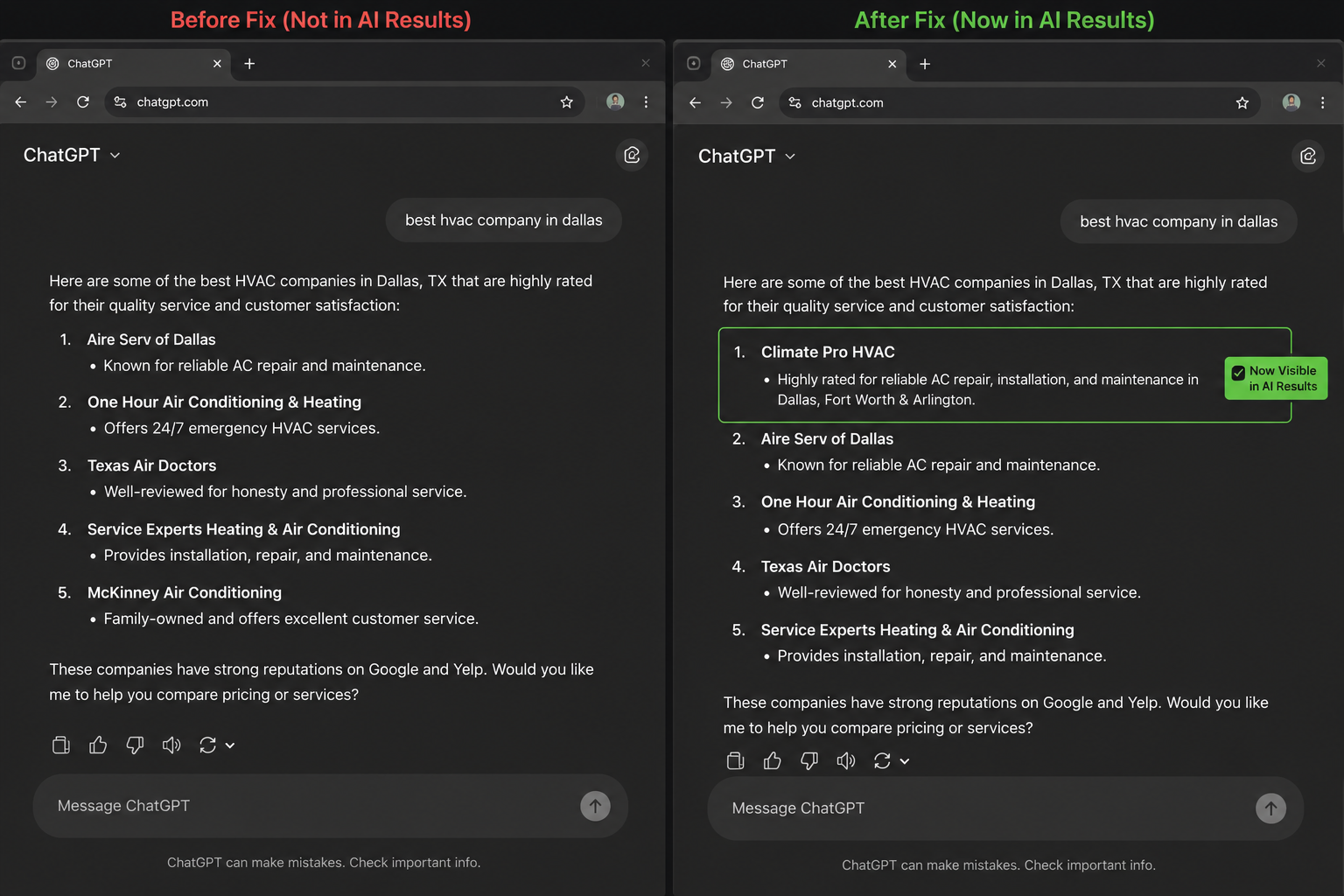
We tested their business across AI search platforms — ChatGPT and Perplexity — using queries like "What are the best HVAC companies in Dallas, TX?" Their business had solid visibility in traditional Google search. It didn't appear in the AI-generated recommendations at all.
What we found: an inconsistency in their local business information that's easy to miss because nothing about it looks broken to a human visitor.
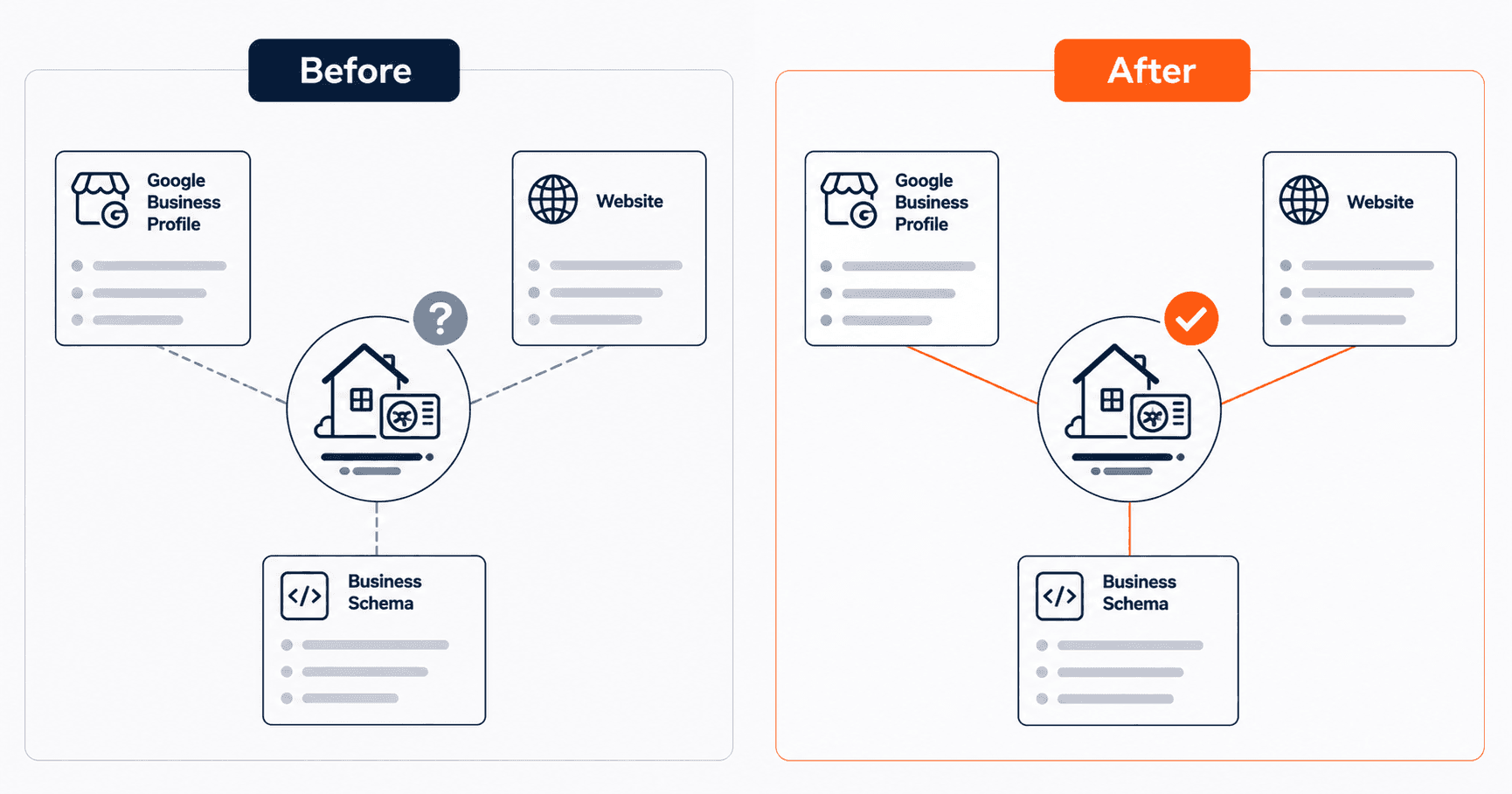
- Their Google Business Profile listed their primary service area as Dallas, TX
- Their website mentioned Dallas, Fort Worth, and Arlington, TX
- Their local business information and location signals weren't fully consistent across the web
- Their LocalBusiness schema hadn't been updated to match the correct service-area information either
None of this was wrong, exactly — it just wasn't the same everywhere. And that's the part that matters for AI systems specifically: a human reading the website understands "we serve three cities" without effort, but a model cross-checking facts across sources sees a mismatch it can't confidently resolve.
What we fixed: we standardized the company's location and service-area information across every relevant business asset — corrected the service-area info, aligned the Google Business Profile and website, updated the LocalBusiness schema, and made sure the business consistently communicated its coverage across all three cities everywhere it appeared.
The result: a few weeks later, we ran the same AI visibility tests again. This time, asking "Who are the best HVAC companies in Dallas, TX?", the client's business started appearing in the AI-generated recommendations.
The takeaway isn't "they optimized for AI" in some mysterious sense. It's simpler than that: we removed conflicting business information and gave search engines and AI systems a clearer, more consistent understanding of the business, its services, and its service area. Better consistency → clearer business signals → a stronger chance of being understood and mentioned by AI search systems. That's the same pattern this whole article has been describing — it just happened to be real, on a real client, this time.
Want to know if this is happening on your own site? Our Local Business AI Visibility tool compares your website against your Google listing and shows you where they disagree.
Frequently asked questions
Does ChatGPT use Google rankings to decide who to recommend? Not directly. It runs its own retrieval and reads a small set of pages, so ranking #1 on Google doesn't automatically mean you get mentioned — and being on page two of Google doesn't automatically exclude you either. There's overlap because both systems reward the same underlying things (clear, trustworthy, well-structured content), but they aren't the same ranking.
Can I pay to get recommended by ChatGPT? No. There's no ad product for this today, and anyone selling "guaranteed ChatGPT placement" is not selling something real. This is one of the few areas where budget doesn't buy an outcome directly — it's closer to earned media than paid media.
How long does it take to start showing up after fixing these things? Honestly, this varies with how often the model re-crawls and re-indexes, which isn't public information. In practice, small structural fixes (schema, crawler access) can show up in test queries within days to a few weeks; the kind of independent-source consistency that builds real trust takes longer, closer to the same 60–90 day timeline as normal SEO.
Does this replace normal SEO? No — it overlaps with it heavily. A well-structured, fast, trustworthy site for humans and Google is most of the way to being AI-visible too. Treat this as an addition (schema, crawler access, cross-source consistency), not a separate discipline competing for the same hours.
Which AI platforms does this actually apply to? This article is about live-search-capable assistants specifically — ChatGPT with browsing, Perplexity, and Google's AI Overviews. Fully offline chat responses (no browsing) behave differently and mostly reflect training-data patterns, which is a separate, slower-moving problem.
The honest summary
Nobody fully knows the ranking logic, including the companies that built these models. But the pattern I keep seeing across real client sites is boring and consistent: the businesses that show up are the ones where the facts about them are structured, consistent, and independently confirmed across the web — not the ones that spent the most, or wrote the most keyword-stuffed pages. That's genuinely good news for smaller businesses, if you're willing to do the unglamorous fixing-your-robots.txt-and-schema work instead of chasing a shortcut.
Founder, Alrebro
Fazal Ur Rehman is the founder of Alrebro and an AI SEO strategist focused on search visibility, technical SEO, and digital growth. He shares practical insights, industry trends, and actionable strategies to help businesses succeed online.
More from Fazal Ur RehmanRelated articles
How to Appear in Google AI Overviews and Gemini: What Actually Works in 2026
How to rank in Google AI Overviews and Gemini in 2026: what Google actually says, which local searches trigger them, and what works for small businesses.
How to Rank in Perplexity AI in 2026: A Practical Guide for Small Businesses
How to rank in Perplexity in 2026: how it picks and cites sources, and a 7-step plan small businesses can use to show up in Perplexity answers.
Why Doesn't ChatGPT Recommend My Business? 9 Reasons (And How to Fix Each One)
Why doesn't ChatGPT recommend my business? 9 common reasons local businesses stay invisible in ChatGPT, with a plain-English fix for each one.
Get new articles in your inbox
No spam — just SEO strategy and updates, occasionally.
This site is protected by reCAPTCHA and the Google Privacy Policy and Terms of Service apply.
Find out what's actually wrong
39 checks, your off-page signals, and a plan you can act on. Free, about a minute, no account needed.