How to Get Your Business Recommended by ChatGPT (The Honest 2026 Guide)
There is no form that submits your business to ChatGPT. Its recommendations are assembled from signals you can influence — here are the seven that matter, in order, plus a live test run against our own business.
On this page15 sections
- First, run the test
- What that test looks like when you fail it
- How ChatGPT actually decides who to recommend
- The seven steps, in order of impact
- Step 1 — Make sure ChatGPT's crawlers can read your site at all
- Step 2 — State exactly what your business is, in machine-readable form
- Step 3 — Get your Google Business Profile complete and your reviews real
- Step 4 — Make every mention of your business match exactly
- Step 5 — Publish direct answers to the questions buyers actually ask
- Step 6 — Earn mentions on real third-party sites
- Step 7 — Measure it, on a schedule
- The advice you can safely ignore
- What timeline to actually expect
- FAQ
- Where this leaves you
There is no form, directory, or paid placement that gets your business recommended by ChatGPT. Anyone selling you a "submission service" is selling something that doesn't exist. But ChatGPT's recommendations are not random either — they're assembled from signals on the open web that you can directly influence: what your site states about you, what AI crawlers can read, what reviews and third-party sources say, and how consistently it all matches.
This guide covers how ChatGPT actually chooses businesses to name, the steps that genuinely move the needle (in order of impact), a live test you can run on your own business in the next five minutes, and — because this field is full of it — the popular advice you can safely ignore.
First, run the test
Before optimizing anything, find out where you stand. Open ChatGPT and ask, exactly the way a customer would:
- "What is [your business name] in [your city]?"
- "Who are the best [your category] in [your city]?"
- "I need [your service] in [your city] — who should I consider?"
Three outcomes are possible. You're named and described accurately — you're ahead; your job is defending and extending it. You're named but described wrongly — wrong city, wrong services, confused with someone else — the most dangerous outcome, because it repeats in conversations you never see. You're absent — the most common outcome for local businesses, and the one this guide fixes.
Want the structured version? Our AI Answer Simulator sends a live query to a real AI model and shows you its actual answer, and the AI Visibility Checker runs multiple prompts and scores the results.
What that test looks like when you fail it
Here is the simulator run against our own business, on the day this article was written. We are an AI SEO agency writing a guide about being recommended by AI, so it seemed only fair to go first:
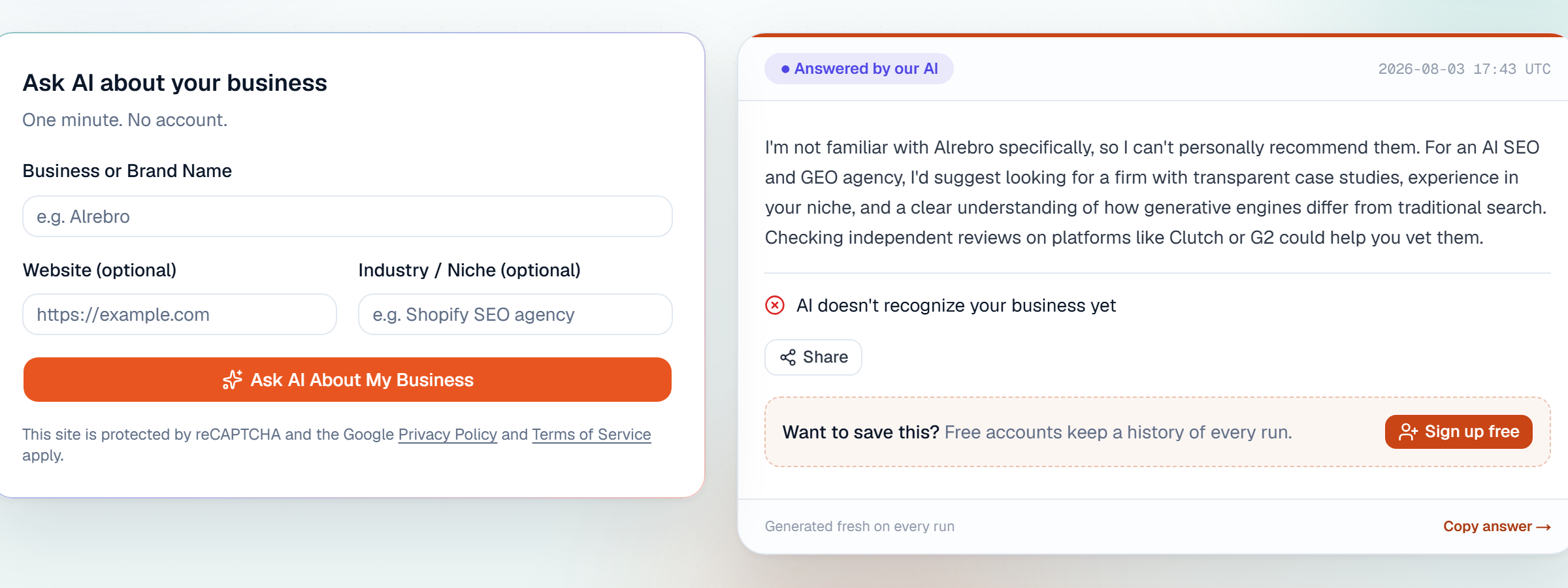
The answer, verbatim:
I'm not familiar with Alrebro specifically, so I can't personally recommend them. For an AI SEO and GEO agency, I'd suggest looking for a firm with transparent case studies, experience in your niche, and a clear understanding of how generative engines differ from traditional search. Checking independent reviews on platforms like Clutch or G2 could help you vet them.
That's a fail, and it's ours. The tool's verdict line reads "AI doesn't recognize your business yet." No amount of knowing how this works exempts you from having to do it.
Two things in that answer are worth reading closely, because they are the whole article in miniature.
First, the model didn't invent anything. It didn't guess a location, hallucinate a founding year, or confuse us with a similarly named company. It said it didn't know, then described what would make a business in our category recommendable: transparent case studies, niche experience, demonstrable understanding, independent reviews. That list is not a coincidence — it is a plain-language restatement of the signals the steps below are built on.
Second, it reached for third-party validation. Clutch and G2 weren't in our prompt. The model volunteered them, because when it can't vouch for a business itself it looks for somewhere independent that can. Step 6 exists because of exactly this reflex.
One honest caveat about this test, which you'll notice the moment you run it twice: the answers vary between runs. We ran the same query three times while writing this. One run named BrightEdge, Conductor and MarketMuse as alternatives to consider. Another gave the answer above, with no competitors named at all. Same business, same prompt, minutes apart. That variance is normal and it matters for how you measure — a single answer is an anecdote, not a baseline. Run the same questions several times before you conclude anything, and see Step 7.
How ChatGPT actually decides who to recommend
ChatGPT answers from two layers, and each needs different work:
Layer 1 — what the model already "knows." Training data: the web as it existed when the model was trained. If your business had a clear, consistent, well-described presence across your site, reviews, and third-party mentions over the past years, the model may know you. This layer changes slowly — you influence it by building the record now that future training runs will read.
Layer 2 — what it looks up live. For current or commercial questions ("best plumber near me"), ChatGPT increasingly searches the web in real time using its own crawlers (OAI-SearchBot, ChatGPT-User). This layer you can influence this week: if those crawlers can read your site and your pages answer the question clearly, you're in the candidate pool today. (For the mechanics of that live-search step — what it actually searches, reads, and cross-checks before writing an answer — see How Does ChatGPT Decide Which Businesses to Recommend?.)
Both layers reward the same fundamentals: clarity, consistency, credibility, and machine-readability. That's why the steps below aren't ChatGPT tricks — they're the same foundation that works across Perplexity, Claude, and Google's AI Overviews (covered fully in our GEO guide).
The seven steps, in order of impact
Every step below maps to a real check our free scan runs — the check name is listed, so you can verify your own status rather than taking our word.
Step 1 — Make sure ChatGPT's crawlers can read your site at all
Checked as: AI Crawler Access · Robots.txt Blocking Crawlers
The single most common failure, and the cheapest fix. If your robots.txt blocks OAI-SearchBot or ChatGPT-User — often added silently by a plugin or a copied template years ago — you are opted out of live recommendations regardless of everything else you do. Test yours in under a minute.
One client came to us after noticing their site almost never appeared in AI answers despite genuinely good content; their robots.txt was blocking key AI crawlers, a setting nobody remembered adding. The full version of that story is in the GEO guide.
Step 2 — State exactly what your business is, in machine-readable form
Checked as: Entity Clarity · Structured Data (Schema)
ChatGPT can't recommend what it can't confidently identify. LocalBusiness/Organization schema states your name, category, location, services, and contact details in a format with no room for interpretation — the difference between being "a business that might do X somewhere" and "the [category] in [city] that does X." Generate a valid starting point free, then make sure every claim in it matches your site's visible text.
Step 3 — Get your Google Business Profile complete and your reviews real
This surprises people: your Google Business Profile matters for ChatGPT, not just Google. AI systems lean on established, structured sources when assessing local businesses — and your GBP (categories, hours, service areas, photos, and especially reviews) is among the strongest.
Completeness is the part most businesses stop short on. A profile with a primary category and nothing else is technically filled in and practically useless. The fields that carry real weight:
- Primary category, chosen precisely. "Plumber" and "Emergency plumbing service" surface for different questions. Pick the one that matches what you actually want to be asked for, then add secondary categories for the rest rather than compromising on the primary.
- Service areas, stated explicitly. If you cover six towns, list six towns. An AI answering "who covers [town]" has no way to infer your radius from an address.
- Services and products, itemised. Each entry is another phrase your business is legitimately associated with.
- Hours, including holiday hours. Stale hours are the most common contradiction between a GBP and a website, and contradictions are what Step 4 is about.
- Photos, dated and real. They don't feed the text of an AI answer, but they feed the profile's credibility signals, and an abandoned-looking profile is a weak source.
On reviews, quantity is the obvious half and specificity is the half that matters. "Great service, highly recommend" is a five-star review that contains no information. "They fixed our AC the same day in [town] after two other companies quoted a week" contains a service, a turnaround, a location and a differentiator — the natural language that matches how people actually phrase questions to an assistant. When you ask for reviews, ask customers what problem you solved and where, and you get the second kind without scripting anyone.
Respond to reviews, too — including the bad ones, plainly and without defensiveness. A visible, non-generic response pattern is a credibility signal a machine can read, and a business that answers criticism in public is a safer thing to recommend than one that doesn't.
One thing we won't tell you to do: buy, fake, or incentivize reviews into existence. Beyond the platform risks, AI systems synthesize across sources — a review profile that contradicts your actual footprint reads as noise, not authority.
Step 4 — Make every mention of your business match exactly
Checked as: NAP Consistency · Contact Info Clarity
Your site, your GBP, your social profiles, old directories: name, address, phone — identical everywhere, down to formatting. Conflicting details read as uncertainty to a system deciding whether to state a fact about you, and an uncertain AI's safest move is to skip you entirely. Tedious, unglamorous, and one of the most reliably effective fixes for local businesses.
Step 5 — Publish direct answers to the questions buyers actually ask
Checked as: Direct-Answer Structure · FAQ Schema Markup
Take the questions you answer on every sales call — how much, how long, do you handle X, what if it goes wrong — and answer them on your site, directly, near the top of the page, marked up as FAQs. This is the most extractable content format there is, and it's what Layer 2 retrieval quotes. An answer that only exists in your phone calls helps nobody asking ChatGPT at 11pm.
Step 6 — Earn mentions on real third-party sites
ChatGPT triangulates. A business its search finds described consistently on its own site, in reviews, AND on independent sites is a safe recommendation. A business that only describes itself is a weaker one — and you saw that reflex in the test above, where the model reached for Clutch and G2 unprompted rather than take our own word for anything.
In rough order of how much they're worth for a small business:
- Local and trade press. A named mention in a publication that covers your area or industry is the strongest ordinary business can realistically earn. Being the business quoted in a story about your trade is worth more than a dozen listings.
- Supplier, manufacturer and partner pages. Badly underused. If you're a certified installer, an authorised dealer, or a named partner, the manufacturer very likely has a locator or partner page you're entitled to appear on. It's independent, it's category-specific, and it usually costs a phone call.
- Industry associations and licensing bodies. Membership directories carry weight precisely because membership is verifiable.
- Genuine niche directories. Not link farms — the two or three directories real customers in your category actually use.
- Guest articles on real publications. Worth it when the publication has its own readership and editorial standards. Worthless when it exists to sell placements.
The test for all of these: would a customer plausibly encounter this page? If yes, it's a real mention. If it only exists for search engines, it's the kind of thing bought links are made of — and we'd know, because link building done honestly is one of the things we sell, and "no bought links" is in the service description.
One caveat worth stating: consistency (Step 4) applies here too. A partner page listing your old phone number is a third-party source contradicting you, which is worse than no listing at all. When you claim these placements, check what they actually say.
Step 7 — Measure it, on a schedule
Re-run the same questions monthly, record what changed. Presence (named at all?), accuracy (facts right?), prominence (first-named or passing mention?). One honest warning, demonstrated above: AI answers vary between runs — the same question can produce different lists minutes apart. That's normal; track trends over multiple samples, not single answers. The AI Visibility Checker structures this for you.
The advice you can safely ignore
Plenty of "get recommended by AI" advice is either useless or harmful. The short honest list:
- "Submit your business to ChatGPT" services — no such mechanism exists. Anyone selling access is selling air.
- Guarantees — "we'll get you into ChatGPT's answers in 30 days." Nobody controls the platforms' selection, the rules aren't published, and answers vary between runs. Guarantees here are a red flag, full stop — and yes, that standard applies to us too.
- Mass AI-generated content dumps — flooding your site with generic AI articles to "feed the model." The systems are choosing what looks like evidence and experience; generic volume is the opposite signal, and it's also the pattern Google actively demotes.
- Statistics without sources — you'll find articles on this exact topic quoting precise-sounding visibility percentages and lead-increase numbers with no verifiable source. Treat unverifiable numbers as marketing, not data. (You'll notice this article quotes none.)
My honest take after fourteen years in SEO: the businesses winning AI recommendations right now aren't doing anything exotic. They're the ones whose basic facts are clean, consistent, and readable everywhere — because so few businesses have actually done that, it's still a competitive advantage. The window where "just being properly set up" wins won't stay open forever.
What timeline to actually expect
The fixes are fast: crawler access is often same-day, schema within days, consistency cleanup within a week or two. AI behaviour changing is slower — most measurable movement comes over weeks to a couple of months, which is why we tell clients 60–90 days for meaningful change. Layer 1 (training data) moves slower still: the consistent record you build now is what future model updates learn from. Start early; the record compounds.
FAQ
Can I pay to be recommended by ChatGPT?
No. There's no advertising or placement product inside ChatGPT's organic recommendations. What you can influence is the open-web record its answers are built from — which is what every step above does.
Why does ChatGPT recommend my competitor and not me?
Usually one of three reasons, in order of frequency: its crawlers can't read your site (Step 1), it can't confidently identify what you are (Steps 2/4), or your competitor's footprint — reviews, third-party mentions, clear answers — is simply stronger on the questions being asked (Steps 3/5/6). The free scan identifies which applies to you.
Does this work the same for Perplexity, Claude, and Google's AI?
The foundations are identical — clarity, consistency, crawlability, credibility. The platforms differ in how much they search live versus rely on training data; the full breakdown is in our GEO guide.
ChatGPT says something wrong about my business. Can I fix it?
You can't edit ChatGPT directly, but wrong descriptions almost always trace to wrong or conflicting information on the open web — your site, an old listing, a stale profile. Fix the sources (Steps 2 and 4), open crawler access so the live layer reads the corrected version, and the descriptions follow. This exact problem — AI stating wrong facts about a business — is one of the things our AI Visibility work checks and tracks.
How do I know if any of this is working?
Same questions, same platforms, monthly, recorded — trends over samples, not single answers. Free version: a spreadsheet and five questions. Structured version: the AI Visibility Checker.
Where this leaves you
The test at the top of this article is the honest starting point, and we published our own failing result rather than a flattering one because the gap between "knows how this works" and "has done the work" is the entire subject here.
None of the seven steps is clever. They are the unglamorous business of being unambiguous: readable to a crawler, identifiable to a machine, consistent everywhere anyone checks, and vouched for by someone other than yourself. Most businesses have not done them, which is exactly why doing them still counts for something.
Start with Step 1, because it takes a minute and it's binary. Then work down the list in order. The record you build now is what the next model learns from.
Find out where you stand right now: run the free scan — it checks every step in this guide against your real site, in about a minute, and the report is yours either way.
Founder, Alrebro
Fazal Ur Rehman is the founder of Alrebro and an AI SEO strategist focused on search visibility, technical SEO, and digital growth. He shares practical insights, industry trends, and actionable strategies to help businesses succeed online.
More from Fazal Ur RehmanRelated articles
The Complete List of AI Crawlers (and Whether to Block or Allow Each One)
Every AI crawler that visits your site does one of three jobs. Here's what each one is — and whether blocking it is a privacy decision or a visibility mistake.
How Does ChatGPT Decide Which Businesses to Recommend?
For anything current or local, ChatGPT almost never answers from memory — it runs a live search, pulls a handful of pages, and pieces together an answer from what those pages say.
Schema Markup for AI Search: What It Actually Does (2026 Guide)
Dozens of guides claim schema gives a "50% lift" in AI visibility with no source behind it. Here's what structured data genuinely does for AI citation, the six schema types worth your time, and how to add them free in about 20 minutes.
Get new articles in your inbox
No spam — just SEO strategy and updates, occasionally.
This site is protected by reCAPTCHA and the Google Privacy Policy and Terms of Service apply.
Find out what's actually wrong
39 checks, your off-page signals, and a plan you can act on. Free, about a minute, no account needed.