What Is Generative Engine Optimization (GEO)? The Complete 2026 Guide
GEO decides whether ChatGPT, Perplexity and Google's AI name your business — or skip it. The research, the platform differences, the six fixes that matter, and a real audit of our own site, findings and all.

On this page17 sections
- The shift, in plain terms
- Where GEO actually comes from — the research
- GEO vs SEO — related, not identical
- How the platforms actually differ
- The six things that decide whether AI names you
- 1. AI crawlers can read your site — *checked as: AI Crawler Access · Robots.txt Blocking Crawlers*
- 2. Your site states unambiguously what your business is — *checked as: Entity Clarity · Structured Data (Schema)*
- 3. Your pages answer questions directly, near the top — *checked as: Direct-Answer Structure*
- 4. The questions customers actually ask are on your site, marked up — *checked as: FAQ Schema Markup · Visible FAQ Content*
- 5. Someone credible visibly stands behind the content — *checked as: Author / E-E-A-T Signals · Content Freshness Signals*
- 6. Your details match everywhere they appear — *checked as: NAP Consistency · Contact Info Clarity*
- The newer technical layer: llms.txt and friends
- A real mini-audit, walked through
- How to measure AI visibility (without fooling yourself)
- What to do this week (owner's checklist)
- FAQ
- The honest closing argument
Generative Engine Optimization (GEO) is the work of making sure AI systems — ChatGPT, Perplexity, Claude, Google's AI Overviews — can find your business, understand exactly what it is, trust it, and name it when someone asks a question you'd want to be the answer to. Traditional SEO competes for a position in a list of links. GEO competes for a place inside the answer itself — because for a growing share of your customers, the list never gets read.
This guide runs two levels deep on purpose. If you own a business and just want to understand what this is and what to do, read straight through — everything is in plain language. If you do this work professionally, the research, platform mechanics, and measurement sections go deeper than the usual definitions-and-vibes treatment of this topic. Both of you will find out the same uncomfortable thing: most websites fail at GEO for reasons nobody on the team knows about.
October 2026 update: What is generative engine optimization, and does your business need it yet? The research, the six checks and the method below are unchanged since first publication. New in this update: two FAQs covering the questions we hear most this year, how GEO works end-to-end and what a practical generative engine optimization strategy looks like in 2026.
The shift, in plain terms
For twenty years, being found online worked one way: someone typed words into Google, got a list, clicked.
Two things broke that pattern at the same time.
Google put AI-written summaries — AI Overviews — above the results for a large share of searches. The summary answers the question, names a handful of sources, and many people never scroll past it.
And a lot of people stopped starting at Google at all. They ask ChatGPT or Perplexity the way they'd ask a knowledgeable friend: "I need an accountant for a small construction company in Denver — who should I look at?" The AI answers in sentences. It names specific businesses.
Here's what matters commercially: in an AI answer, a small number of businesses get named and everyone else is simply absent. Ranking was a spectrum — position four still got some clicks. Being in an answer is much closer to binary. You're in the conversation or you never existed in it.
GEO is the work of getting to yes. It is not magic, it is not a scheme, and — an opinion we'll defend below — about 70% of it is things good technical SEO always rewarded, done properly for the first time. The other 30% is genuinely new, checkable, and where most sites silently fail.
Where GEO actually comes from — the research
"GEO" isn't a marketing invention. The term comes from an academic paper — GEO: Generative Engine Optimization (Princeton University and collaborators, first published 2023) — which did something useful: it tested, systematically, which content changes make AI-generated answers more likely to include a source.
Three findings from that research are worth knowing because they still drive most practical GEO work:
1. Generative engines don't rank pages — they extract and synthesize. The pipeline is retrieval (fetch candidate sources) → synthesis (compress them) → generation (write the answer, with citations). A page has to survive all three stages to appear. This is why GEO work obsesses over extractability rather than keywords: a page can be retrieved and still be dropped at synthesis because nothing in it was quotable.
2. Evidence beats keyword optimization. The paper's tested improvements — adding citations to credible sources, adding quotations, adding statistics — measurably increased a source's visibility in generated answers, with improvements in the range of 30–40% for the strongest methods. Keyword stuffing, the old reflex, did approximately nothing. AI systems are choosing what looks like evidence, not what repeats the query.
3. Query fan-out multiplies your chances — and your risks. Generative systems rewrite one question into several variants behind the scenes ("things to do in New York" also becomes "top NYC attractions" and so on). Content that covers a topic's natural variations gets more retrieval surface area. Content that answers one phrasing narrowly gets less.
If you read nothing else academic about this field, that paper's core claim is the one to keep: the systems prioritize evidence-rich, clearly structured content over keyword-optimized pages. Everything practical below follows from it.
GEO vs SEO — related, not identical
| Traditional SEO | GEO | |
|---|---|---|
| The goal | Rank a page in a list | Be named inside the answer |
| Who reads your site first | People, after clicking | Machines, before answering |
| What wins | Authority, links, relevance | Clarity, structure, evidence, consistency |
| Failure mode | Ranking lower | Not being mentioned at all |
| Measurement | Positions, clicks | Mentions, accuracy of what's said, citations |
The overlap is real: a slow, broken, unindexable site fails at both. But the emphasis genuinely differs, and this is where an honest opinion belongs. GEO vs SEO has the full comparison and a straight answer on which one your business needs, by business type.
After fourteen years of doing SEO, my view is that most of what's sold as "GEO strategy" right now is technical SEO hygiene with a new invoice attached — and the parts that ARE new (entity clarity, answer-first structure, crawler access for AI user-agents, FAQ extraction) are cheap, unglamorous fixes that most agencies skip because they're tedious, not because they're hard. If someone quotes you a large monthly fee for "AI optimization" and can't show you a specific list of what's broken on your specific site, walk away.
How the platforms actually differ
"AI search" is not one thing. The systems behave differently in ways that change what you optimize for — and any guide that treats them as interchangeable hasn't looked closely.
ChatGPT — answers from two places: its training data (what it learned historically) and, when it decides the question needs it, live web search with citations. For business recommendations it increasingly searches. Practical consequence: your historical web presence shapes what it "knows" about you, AND your current crawlability (GPTBot, ChatGPT-User agents) shapes whether it can check you live. You need both. (Step-by-step for this platform specifically: How to Get Your Business Recommended by ChatGPT.)
Perplexity — search-first by design. Every answer is built from live retrieval and always cites sources. Practical consequence: this is the platform where classic ranking signals and GEO overlap most — if you're retrievable and quotable for a query, you can appear quickly, without years of brand history. It's also the most measurable platform, which makes it the best early scoreboard.
Google AI Overviews — generated from Google's own index and systems. Practical consequence: traditional Google SEO is the entry ticket; there is no AI Overview presence for a site Google's index doesn't already trust. The extra GEO layer decides whether your content is the extractable piece the Overview quotes.
Claude — historically leaned on training data; now performs web search with citations in consumer products. Its crawlers (ClaudeBot, Claude-SearchBot) are among the most commonly blocked-by-accident agents we see.
The pattern across all four: retrieval + understanding + trust. The weightings differ; the ingredients don't. Which is why the fix list below isn't platform-by-platform tricks — it's the shared foundation, plus verification per platform.
One more thing worth saying plainly, because almost nobody selling GEO services says it: API answers and consumer-app answers can differ. A tool that queries a platform's API (including ours) measures via the API, which may not be byte-identical to what a user sees in the app on a given day. Honest measurement states its scope. Ours does.
The six things that decide whether AI names you
These aren't theoretical. Every one is something our scanner genuinely checks against real websites — each heading names the exact check, so if you run a scan you'll recognise these findings, in these words, in your own report.
1. AI crawlers can read your site — checked as: AI Crawler Access · Robots.txt Blocking Crawlers
Your robots.txt file tells automated visitors what they may read. In 2023, a wave of sites added rules blocking AI crawlers — sometimes as a deliberate stance, very often because a plugin or copied template did it silently.
Those same crawlers are now how AI systems learn what exists and check what's current. Blocking GPTBot or ClaudeBot today doesn't protect your content from anything — it removes you from the pool of businesses available to recommend.
This is the most common invisible GEO failure we find, and it's usually a one-line fix.
Here's what it looks like in practice. A client came to us after noticing their site rarely appeared in AI-generated answers despite genuinely good content. The audit found the answer in the first file we opened: their robots.txt was blocking key AI crawlers from important pages — a configuration nobody remembered setting. We updated the crawl rules, cleared a few related technical issues, and the site became fully accessible to AI crawlers. Visibility improved over the following weeks — not overnight, which is the honest version of this story.
Check yours in under a minute: Website AI Readiness Audit (free with an account), and the full walkthrough: Is Your Site Blocking AI Crawlers?
2. Your site states unambiguously what your business is — checked as: Entity Clarity · Structured Data (Schema)
A human reading your homepage works out what you do. A machine has to extract it — and "approximately right" is worse than wrong, because an AI that half-understands you will confidently repeat the half-truth in conversations you never see. Wrong city. Wrong category. Confused with a similarly named company.
The fix is structured data: Organization or LocalBusiness schema stating your name, category, location, contact details, and profiles in a format with no room for interpretation. Most small-business sites don't have it. Many that do have it half-filled, invalid, or contradicting their own Google Business Profile.
Check what you already have: the Website AI Readiness Audit reads your structured data and shows what is missing. But writing the schema is the easy half — making the same facts true everywhere they appear is the half that moves results (see point 6).
3. Your pages answer questions directly, near the top — checked as: Direct-Answer Structure
Human writing builds to its point. Machine extraction wants the point first.
When a system needs a specific answer — cost, duration, coverage area — it looks for content stating it plainly, early, under a clear heading, and moves on if it doesn't find one. A page that spends four paragraphs warming up reads, to a machine, like a page that doesn't answer the question. Notice this article's first sentence is the definition. That's not style; that's the tactic, demonstrated.
The fix is reordering, not cutting. Thin pages don't get cited either — the research above is explicit that evidence and depth win. Direct answer first, full depth beneath it.
4. The questions customers actually ask are on your site, marked up — checked as: FAQ Schema Markup · Visible FAQ Content
Every business answers the same handful of questions before every sale. How much. How long. Do you handle X. What happens if it goes wrong.
In question-and-answer format with FAQPage markup, those are the most extractable content you can publish — literally the shape AI systems handle best. Answered brilliantly on the phone, they help nobody asking ChatGPT at 11pm.
Two distinct failures: no FAQ content at all, or good FAQ content without markup — which reads as ordinary prose to a machine. And one warning from the "don't" file: an FAQ whose answers all funnel to "contact us to find out" is worse than no FAQ. It teaches the system your pages don't answer things.
5. Someone credible visibly stands behind the content — checked as: Author / E-E-A-T Signals · Content Freshness Signals
There's more content online than ever, and a rising share is machine-generated filler. Systems deciding what to trust look for who stands behind a claim: a named author, a real bio, demonstrated experience, a visible maintained-on date.
For a small business this is good news. "Written by the owner, who has done this for fourteen years" beats anything a content mill can fake — but only if it's actually on the page, with Person schema linking author to content. A page with no author is a page nobody stands behind, and it competes accordingly.
6. Your details match everywhere they appear — checked as: NAP Consistency · Contact Info Clarity
Your site says one address. Your Google Business Profile abbreviates it differently. A directory still lists the phone number you dropped in 2021.
Humans don't notice. Machines do — and to a system deciding whether to state a fact about your business, conflicting sources read as uncertainty. The safe move for an uncertain AI is silence. You don't get described wrongly; you get skipped entirely.
Least glamorous item on the list. For local businesses, one of the most reliably effective. It's never technical difficulty that leaves it undone — it's tedium.
Skip the manual comparison: our Local Business AI Visibility tool (free with an account) checks your site against your Google listing — name, phone, address — and shows what AI says about you locally.
The newer technical layer: llms.txt and friends
Beyond the six fundamentals, an AI-specific technical layer is forming. Honest status report on each piece:
llms.txt — a proposed convention (originated by Jeremy Howard of Answer.AI in 2024): a markdown file at your site root giving AI systems a curated map of your most important content, the way robots.txt gives crawlers rules. Adoption is real but uneven, and — being straight — no major platform has committed to treating it as authoritative. Our position: it costs twenty minutes, it can't hurt, it may help retrieval, and having it signals a site maintained by someone paying attention. We add it. We don't promise it's a ranking lever, because nobody can. Our full guide to llms.txt covers the 2026 adoption numbers, the server-log data on who actually reads these files, and our own file in full.
AI-specific user agents in robots.txt — this one is not speculative. OAI-SearchBot, ChatGPT-User, GPTBot, ClaudeBot, Claude-SearchBot, PerplexityBot, Google-Extended each control different things (search visibility vs. training vs. live fetching). Blanket-blocking or blanket-allowing without knowing which is which is how sites end up invisible by accident. Our scanner checks each agent individually.
Structured data beyond the basics — FAQPage, Service, Product, Breadcrumb, Article schema all extend the same principle as point 2: say it in a form machines can't misread.
What we deliberately don't do: any "AI SEO" tactic that amounts to hiding text for machines, generating fake Q&A at scale, or stuffing pages with fabricated statistics to look "evidence-rich." The research says evidence wins — fabricated evidence is a trust time-bomb with both Google and the AI platforms, and it's the fastest way to convert "approximately right" into "confidently wrong, everywhere, permanently."
A real mini-audit, walked through
Talking about checks is easy. Here's what they look like run against a real site — our own, because auditing yourself in public is the honest version of a demo.
Everything below is one real scan of alrebro.com, run on 3 August 2026. Nothing is reconstructed, and nothing that failed has been quietly left out.
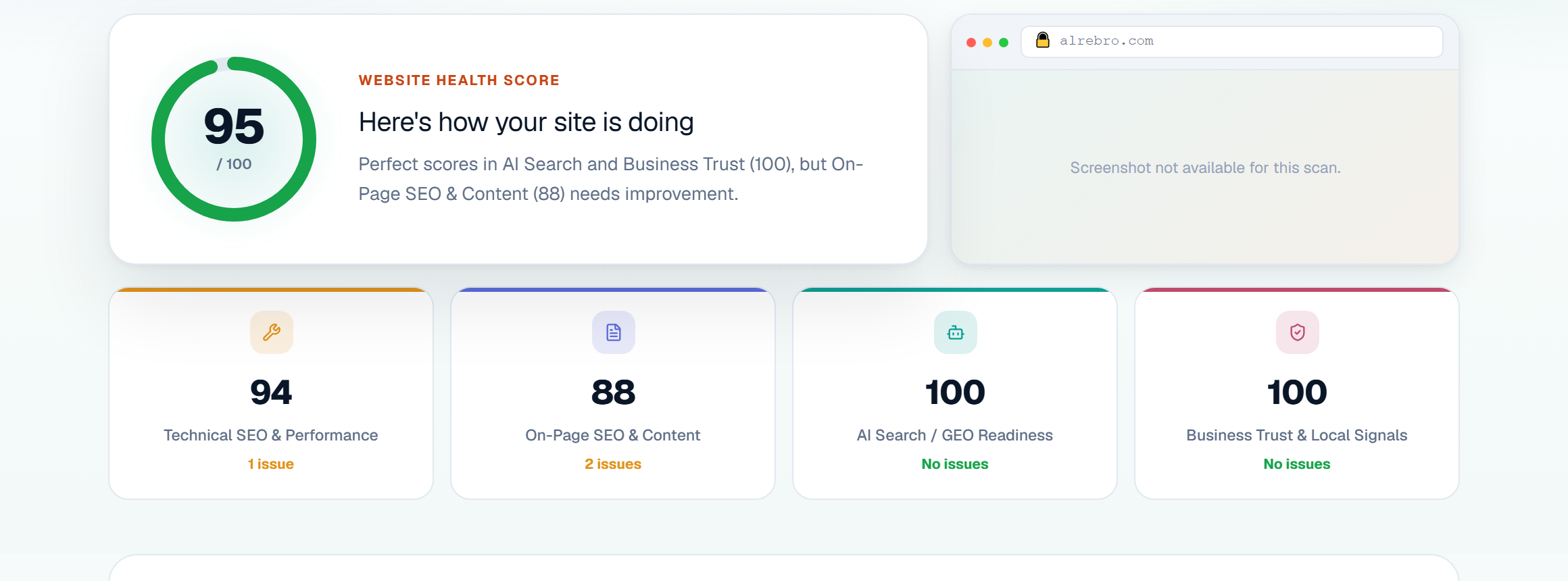
The headline number is 95 out of 100, from 39 individual checks: 29 passed, 3 flagged as issues, and 7 recorded as not applicable to this page type. That last number matters more than it looks, and we'll come back to it.
Crawler access. The scan's AI Crawler Access check passed: none of the seven AI search and training crawlers it tests are blocked. You can reproduce that result yourself in about fifteen seconds — the same crawler-access check runs inside our Website AI Readiness Audit, and here it is run against our own domain:
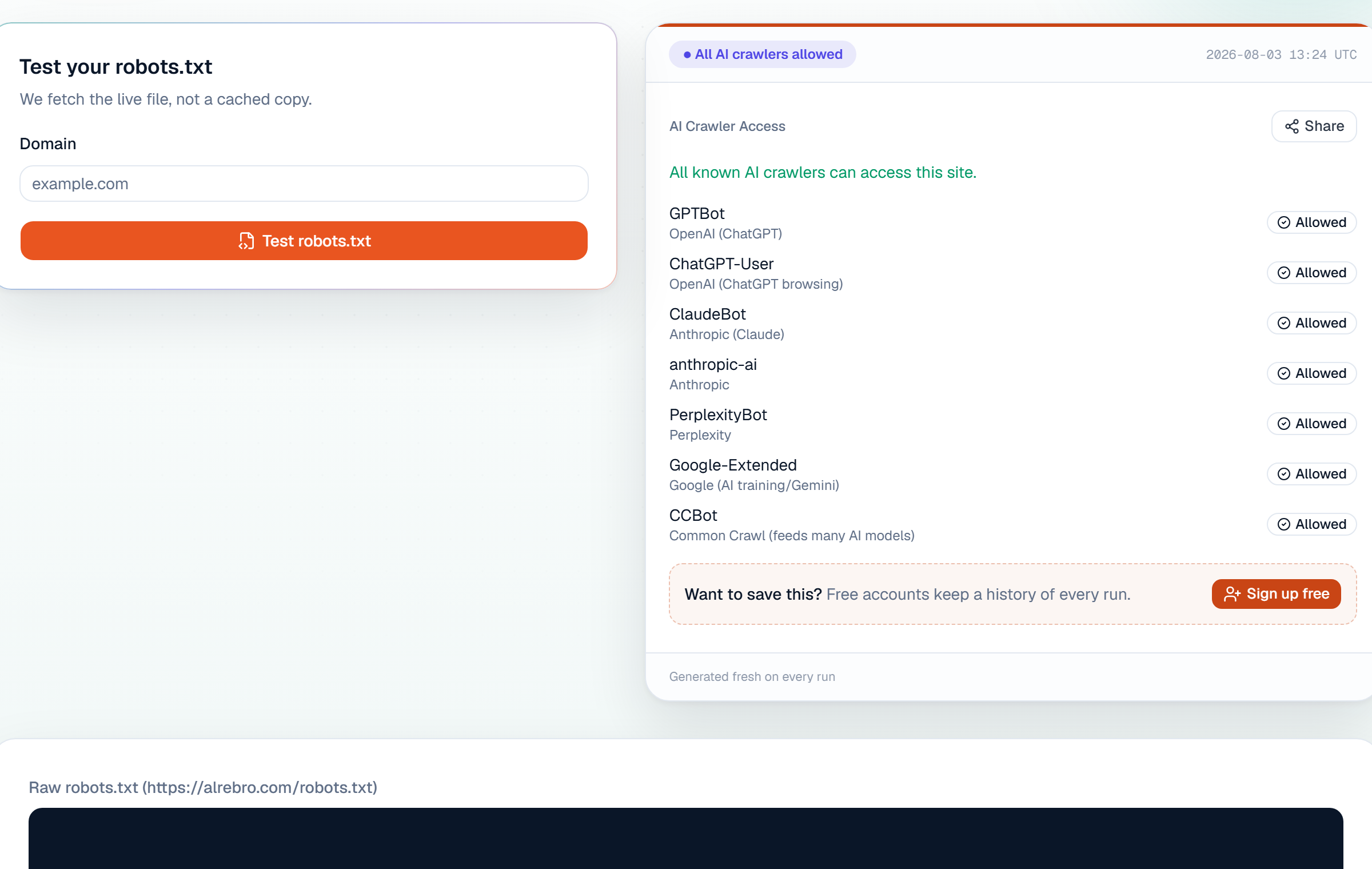
Seven agents, each checked individually rather than as one "AI bots" lump — which is the whole point of point 1 above. If any single one of those said Blocked, that platform's answers could not include us, no matter what else the site did well.
Entity clarity. Also a pass: the scan found both Organization structured data and a link to a real About page, which is the pair it looks for before deciding a business is unambiguously identified. FAQPage schema was found too, along with six question-style headings on the page — points 2 and 4, confirmed by machine rather than asserted by us.
And here's what didn't pass. A demo where everything passes is a demo you shouldn't trust, so here is the actual Priority Action Plan the scan produced for our own homepage:
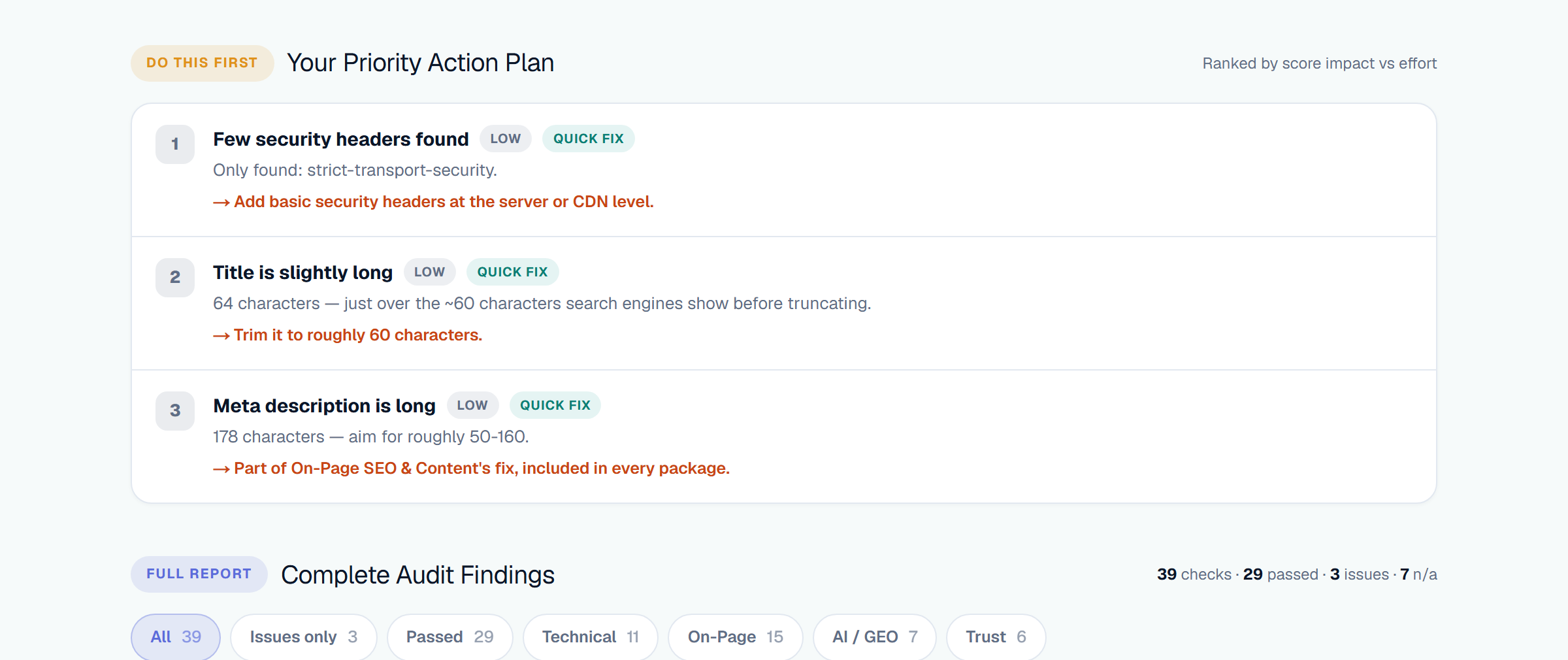
Three open items, all low severity, all real:
- Few security headers found. Our server sends
strict-transport-securityand not much else. It isn't a GEO problem and it isn't urgent, but it's a genuine gap, and it's on our list rather than quietly excluded from the report. - Homepage title length. The title is 64 characters against a 60-character target — a few characters over where search engines start truncating.
- Meta description length. 178 characters against a 50–160 target. Long enough that the end gets cut in a results snippet.
None of these are dramatic. That's rather the point: a site run by people who do this for a living still has three things to fix on its own homepage, and the honest move is to publish them rather than crop them out of the screenshot.
The seven "not applicable" checks deserve a word too, because two of them are the ones point 5 is about: author signals and freshness signals. On a homepage the scanner treats those as not applicable — a homepage isn't article content and doesn't need a byline. On this article, they very much do apply, which is why this page carries a named author, a linked bio, a published date and an updated date. We'd rather pass our own check than write about it.
The point of showing this isn't that our site is perfect — the scan above shows it isn't. The point is that every claim in this guide is checkable, in minutes, against any site, including ours. Run it against yours and you'll see the same check names you just read.
How to measure AI visibility (without fooling yourself)
The maturing-but-real part of GEO. What honest measurement looks like:
What to track: (1) Presence — for a fixed set of realistic questions, does the AI mention you at all? (2) Accuracy — when it mentions you, are the facts right? (3) Prominence — first-named, in the list, or a passing mention? (4) Citations — when answers cite sources, is your domain one of them?
How to track it: the same questions, to the same platforms, on a schedule, with responses recorded — so change over time is real data, not impressions. You can start manually with five questions in a spreadsheet, monthly. Our AI Visibility Checker runs a structured version free, and its "Ask your own question" mode shows you a live answer about your business today.
What to be suspicious of: any tool or agency reporting your "AI ranking" as a single confident number without telling you which questions, which platforms, measured how, via API or app. AI answers vary between runs; honest measurement embraces that (multiple samples, trends over time) rather than hiding it. And no one — including us — can promise that a specific platform will name you for a specific question by a specific date. The systems don't publish their selection rules and the rules change. What honest work does: remove every reason to be skipped, then measure what actually happens.
Realistic timeline: the fixes are fast — crawler access same-day, schema within days. AI behaviour changing is slower: most measurable movement we see comes over weeks to a couple of months, and we tell clients 60–90 days for meaningful change because that's what's true.
What to do this week (owner's checklist)
- Ask ChatGPT and Perplexity: "What is [your business] in [your city]?" and "Best [your category] in [your city]?" — note if you're named, and whether what's said is accurate.
- Test your robots.txt with the Website AI Readiness Audit — one minute, catches the most common silent failure.
- Google your own business name; compare your site, Google Business Profile, and directories side by side. Mismatches = found work.
- Check the questions customers ask you by phone — are the answers on your site, in Q&A form?
- Run the full scan — all six areas plus your technical SEO, against your live site, free, and the report is yours whether you ever spend anything with us or not.
FAQ
How does GEO work, step by step?
Three stages, in order. This is the GEO meaning in practice, not just as a definition.
1. Retrieval. When someone asks an AI assistant a question, it fetches candidate sources from its index or a live web search. If your page isn't retrievable (blocked AI crawlers, no index presence), you're out before the process starts.
2. Synthesis. It compresses those sources and keeps whatever is directly quotable: clear definitions, statistics with named sources, stated facts. Vague marketing copy gets dropped at this stage. That is why a 2023 GEO study by researchers at Princeton and other institutions (read the paper) found that adding citations, quotations and statistics lifted visibility by 30–40%, while keyword stuffing barely helped.
3. Generation. It writes the answer and names the sources it leaned on.
So GEO is the work of surviving all three stages. Be fetchable (crawler access, technical SEO). Be quotable (direct answers first, clear headings, evidence). Be trustworthy (consistent facts everywhere, real authorship). Miss any single stage and you're invisible, which is also why the six checks above are ordered the way they are.
What does a generative engine optimization strategy look like in 2026?
Short version: fix the foundation first, then build the citable layer.
First, unblock and clarify. That means AI crawler access (a common silent failure), Organization or LocalBusiness schema stating exactly what the business is, and one consistent name, address and phone number across your site, Google Business Profile and directories. These are days-to-weeks fixes, not projects.
Second, make pages quotable. Put direct answers early under clear headings. Add real FAQ content with FAQPage markup, not "contact us to find out" non-answers. Tie statistics and claims to named sources.
Ongoing, publish evidence. Original data, documented results and named-author articles are the material AI systems prefer to cite over generic content.
Measure monthly, not daily. For a fixed set of real customer questions, track three things: are you mentioned at all, are the facts right, and are you cited? For the ChatGPT side specifically, see how to get your business recommended by ChatGPT. Technical fixes land fast, but AI behavior shifts more slowly. Our guidance in this article is 60–90 days for meaningful movement, and that hasn't changed.
Is GEO just SEO with a new name?
They share a foundation — a broken site fails at both — but the emphasis differs. SEO asks how you rank for a query; GEO asks whether you're mentioned in an answer, which turns on clarity, structure, evidence, and consistency more than position. And per the research this field is named after, the strongest levers (citations, quotations, statistics, extractable structure) barely featured in traditional SEO checklists.
Do I need GEO if I'm a local business?
Arguably more than anyone. "Who's a good [trade] near me" and "what does [service] cost in [city]" are exactly what people now ask AI assistants — and the local fixes (consistency, Google Business Profile, real FAQs) are the cheapest on the whole list.
Can you guarantee I'll show up in ChatGPT?
No, and nobody honest can — the platforms don't publish selection rules and change them without notice. What can be guaranteed: every checkable blocker removed, and real before/after measurement of what the platforms actually say.
Is it too early to bother with this?
The opposite risk is bigger. The foundations (all six checks above) are also just good technical SEO — there is no scenario where fixing them is wasted. Waiting until "GEO matures" means competitors' clean, consistent, extractable sites spend the intervening years becoming the sources AI already trusts.
How is this different from what Ahrefs or Semrush tell me?
Those tools measure traditional search well, and increasingly report AI visibility too. The difference isn't the finding — it's that a tool hands you the list, and we fix the list, then re-run the same checks to show what changed.
Which platforms do you actually check?
Only the ones we genuinely query — results never include placeholder rows for platforms we don't have real access to. Measurements run via provider APIs, which we state plainly because API answers and consumer-app answers can differ.
The honest closing argument
Fourteen years in, this is the most winnable moment I've seen for small businesses that are willing to be precise about themselves. The old game rewarded budget: more links, more pages, more spend. This one rewards being unambiguous — saying clearly what you do, where you do it, and what it costs, in a form a machine can lift without guessing.
That is not a big-budget advantage. It is a small-team advantage, because a small team can actually make every page, profile and directory listing agree with each other, and a large one usually can't.
The businesses that will get named in AI answers over the next few years are not the loudest. They are the ones that were easiest to understand and safest to repeat.
Find out where you stand: run the free scan — every check in this guide, against your real site, in about a minute. You keep the report either way.
Sources
- Aggarwal et al., "GEO: Generative Engine Optimization", 2023: https://arxiv.org/abs/2311.09735
Founder, Alrebro
Fazal Ur Rehman is the founder of Alrebro and an AI SEO strategist focused on search visibility, technical SEO, and digital growth. He shares practical insights, industry trends, and actionable strategies to help businesses succeed online.
More from Fazal Ur RehmanRelated articles
How to Appear in Google AI Overviews and Gemini: What Actually Works in 2026
How to rank in Google AI Overviews and Gemini in 2026: what Google actually says, which local searches trigger them, and what works for small businesses.
How to Rank in Perplexity AI in 2026: A Practical Guide for Small Businesses
How to rank in Perplexity in 2026: how it picks and cites sources, and a 7-step plan small businesses can use to show up in Perplexity answers.
Why Doesn't ChatGPT Recommend My Business? 9 Reasons (And How to Fix Each One)
Why doesn't ChatGPT recommend my business? 9 common reasons local businesses stay invisible in ChatGPT, with a plain-English fix for each one.
Get new articles in your inbox
No spam — just SEO strategy and updates, occasionally.
This site is protected by reCAPTCHA and the Google Privacy Policy and Terms of Service apply.
Find out what's actually wrong
39 checks, your off-page signals, and a plan you can act on. Free, about a minute, no account needed.