What Is llms.txt? The Honest Guide for Business Owners (2026)
A plain-text map of your site for AI systems, made in twenty minutes. The 2026 data says it earns no citation boost and 97% of these files are never even requested — here is why we still publish ours, and exactly how to build one.
On this page7 sections
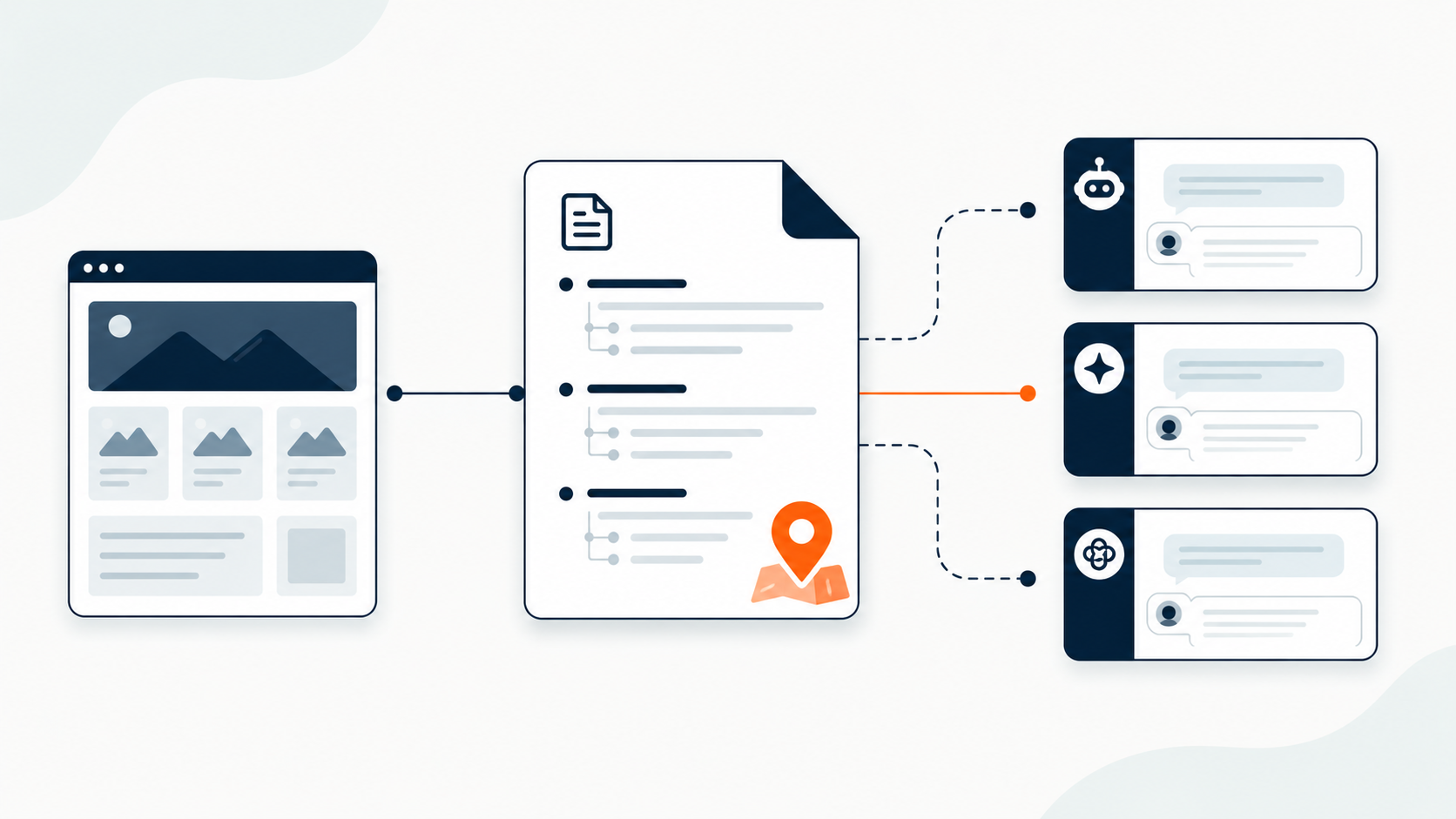
llms.txt is a plain text file placed at the root of your website — yoursite.com/llms.txt — that gives AI systems a curated, readable map of your most important pages, with a one-line description of each. It was proposed in September 2024 by Jeremy Howard of Answer.AI, it's written in simple Markdown, and it takes about twenty minutes to create.
That's the what. The more useful question is whether it actually does anything — and that's where most articles on this topic either oversell or hand-wave. This one won't: we'll show you the real 2026 adoption data, what it does and doesn't prove, why we add the file to client sites anyway, and exactly how to make yours.
The idea behind it, in one minute
robots.txt tells crawlers what they may read. llms.txt tells AI systems what they should read — a shortcut past your navigation, scripts, and clutter, straight to the pages that best explain who you are and what you do.
The logic is sound: AI systems work within limits on how much of a site they can fetch and process. A curated index means less guessing about which of your 400 URLs actually matter. Documentation-heavy companies were the first movers, and there's a companion format — llms-full.txt — that goes further by including full page content, not just links.
What the 2026 data actually shows (the part most guides skip)
Three independent data sources are worth knowing, because together they cut through the hype in both directions.
Adoption is real but minority. Rankability's monthly tracker puts llms.txt at 8.7% of the top 1,000 websites as of June 2026. That headline number is deliberately conservative — it keeps unreachable domains in the denominator, and roughly 450 of that top 1,000 are CDNs, DNS hosts and cloud APIs that don't serve a public site at the root and therefore can't publish one. Among the 549 sites that could actually be reached, adoption is 15.8%. SE Ranking's larger study across ~300,000 domains found 10.13% adoption, and — interestingly — it was nearly flat across traffic tiers: 9.88% for low-traffic sites, 10.54% for mid-traffic, 8.27% for the highest-traffic. Big authoritative brands are not leading this. Mid-sized sites are slightly ahead.
No measured citation benefit. SE Ranking went a step further and tested whether having an llms.txt correlates with being cited more often by AI systems. It doesn't. There was no statistically significant relationship, and their predictive model for AI citations actually got more accurate when the llms.txt variable was removed — the file was contributing noise, not signal. As of mid-2026, no major AI platform has publicly committed to treating llms.txt as authoritative for search or answers.
And the finding that surprised us: almost nothing is reading them. Ahrefs analysed server logs for all 137,210 domains in its Web Analytics that received traffic in May 2026. Of the ~38,000 with a valid llms.txt, 97% received zero requests for that file in the entire month. The largest single category of requests to the files that were fetched was SEO audit tools — not AI systems. Ahrefs also checked who probes for missing llms.txt files and found the AI-bot share of those 404s was zero: the people typing /llms.txt into a browser are humans, mostly SEOs checking on competitors.
That last one deserves to be stated plainly, because it kills a claim you'll read everywhere — including in an earlier draft of this very article. AI crawlers do not roam the web hunting for llms.txt files. When an AI tool does fetch one, it's because a link, an index, or a user instruction told it the file was there.
Any article telling you llms.txt is a "secret weapon for AI rankings" is contradicting the best available data. We'd rather you hear that from us.
So why do we still add it? Four honest reasons
If the data says no citation boost, and 97% of these files are never even requested, why does our own site have one, and why do we add it for clients?
1. The cost is twenty minutes. This is the cheapest item on the entire AI-readiness list, and with the evidence looking the way it does, this is now the reason doing the other three rest on. When something costs almost nothing and carries no downside, the bar for "worth it" is very low. It is not "this will work." It is "this is too cheap not to have."
2. It's a cheap option on a convention that hasn't resolved yet. We used to justify this by saying the files were already being read. The Ahrefs data says that's not true at scale, so we've stopped saying it. What's left is a genuine but smaller argument: the convention is two years old, the cost of holding the position is one file, and "ignored in 2026" can become "expected in 2027" without warning. We saw that pattern with structured data a decade ago — early adopters paid twenty minutes, late adopters paid catch-up. That's a bet on optionality, not a prediction, and you should treat it as one.
3. It already works in one real niche. Developer tools — AI coding assistants and documentation systems — genuinely consume llms.txt today, because in that context something usually does point at the file explicitly. If your business publishes documentation, guides, or technical content, the benefit isn't speculative. If you're a plumber, it currently is.
4. It forces a useful exercise. Writing an llms.txt makes you decide, explicitly, which ten-or-so pages best explain your business, and write one honest sentence about each. Most owners have never made that list. We hadn't written ours down in one place either until we built the file below, and the exercise caught two pages whose descriptions didn't match what the page had become. That clarity improves your site's structure whether or not any AI reads the file.
What we will NOT tell you: that llms.txt substitutes for the fundamentals. If your robots.txt blocks AI crawlers, your business has no structured data, and your pages bury their answers — an llms.txt fixes none of it. It's the garnish, not the meal. The meal is in our GEO guide, and it's the work we actually do in our AI SEO & GEO service.
What a real llms.txt looks like
Here's ours, in full — you can view the live file at alrebro.com/llms.txt:
# Alrebro

> Alrebro is a digital visibility agency founded in 2012, based in Islamabad, Pakistan, working with clients worldwide. We do AI SEO and Generative Engine Optimization (GEO), technical SEO, link building, guest posting, Shopify SEO, and website design and development. Every engagement begins with a free automated scan of the client's real site, so recommendations come from that site's actual data. Plans are monthly with no lock-in and start at $50/month.

This file is a hand-curated map of the pages that best explain who we are and what we do. It is maintained manually, not generated. Last reviewed: 2026-08-06.

## Start here

- [Home](https://alrebro.com/): What Alrebro does, and the free scan that starts every engagement.
- [About](https://alrebro.com/about): Company background — founded 2012 in Islamabad, Pakistan, small team, what we build and why.
- [How We Work](https://alrebro.com/how-we-work): The process behind every scan and package — how findings are prioritized, what is included, and how our own systems operate.
- [Pricing](https://alrebro.com/pricing): Every plan with its real monthly price and what it delivers each month. Monthly, no lock-in, from $50/month.
- [Contact](https://alrebro.com/contact): How to reach us. Based in Islamabad, Pakistan; we reply within 24 hours.

## Services

- [AI SEO & GEO](https://alrebro.com/services/ai-seo-geo): Getting a business found, understood, and cited by AI search engines and assistants. From $50/month.
- [Technical SEO](https://alrebro.com/services/technical-seo): Core Web Vitals, schema markup, and crawl issues — diagnosed by a real scan, then fixed. From $50/month.
- [Link Building](https://alrebro.com/services/link-building): Relevant, honest placements to close a measured authority gap. No PBNs, no link farms. From $50/month.
- [Guest Posting](https://alrebro.com/services/guest-posting): Pitching real, relevant sites for guest posts that build genuine authority — not spun content on spam blogs.
- [Shopify SEO](https://alrebro.com/services/shopify-seo): Shopify-specific fixes — duplicate titles, missing alt text, broken schema — found by a free scan first.
- [Website Design & Development](https://alrebro.com/services/website-design-development): Sites built to pass Core Web Vitals and be readable by AI search from day one. From $50/month.
- [All services](https://alrebro.com/services): The six engagements above, and the one process shared across them.

## Free tools and scans

- [Free site scan](https://alrebro.com/audit): A live health scan of any website plus a ranked priority list, free, in about a minute. This is the entry point to everything else.
- [All free tools](https://alrebro.com/tools): Twelve free SEO and AI-visibility tools, no payment required.
- [AI Visibility Checker](https://alrebro.com/tools/ai-visibility-checker): How AI assistants describe your business across five real prompts, scored with a documented rubric.
- [AI Answer Simulator](https://alrebro.com/tools/ai-answer-simulator): Sends a live query to a real AI model and shows you its actual answer about your business.
- [Robots.txt Tester](https://alrebro.com/tools/robots-txt-tester): Validates robots.txt and shows whether AI crawlers such as GPTBot and ClaudeBot can reach your site.
- [Website SEO Audit](https://alrebro.com/tools/website-seo-audit): Automated on-page audit of any URL — title, meta description, headings, alt text, structured data, viewport — scored out of 100.

## Guides

- [What Is Generative Engine Optimization (GEO)?](https://alrebro.com/blog/what-is-generative-engine-optimization-geo): Our main reference on being cited by AI answer engines, including what we can and cannot prove.
- [Is Your Site Blocking AI Crawlers?](https://alrebro.com/blog/is-your-site-blocking-ai-crawlers): How to check whether robots.txt is blocking AI crawlers, and how to fix it.
- [How to Get Your Business Recommended by ChatGPT](https://alrebro.com/blog/how-to-get-your-business-recommended-by-chatgpt): What actually influences ChatGPT's recommendations, and the popular advice that does not.
- [Blog](https://alrebro.com/blog): All guides on SEO strategy, AI answer engine optimization, and technical SEO.

## Optional

- [Case studies](https://alrebro.com/case-studies): Real client engagements, with the work and the outcome described.
- [FAQ](https://alrebro.com/faq): Common questions about services, pricing, timelines, and how we work.
- [Privacy Policy](https://alrebro.com/privacy-policy): How we handle personal data.
- [Terms of Service](https://alrebro.com/terms-of-service): Terms governing use of the site and services.
- [Refund Policy](https://alrebro.com/refund-policy): Refund terms for monthly plans.
The format, decoded: an H1 with the site name, a one-paragraph summary in a blockquote, then sections of links with one-line descriptions. Plain Markdown. Nothing clever — the simplicity is the point.
Three choices in there are worth explaining, because they're the ones people get wrong.
The summary paragraph does the heaviest lifting. If an AI system reads one thing and stops, it's that blockquote. Ours states the category, the founding year, the location, the six service lines, the fact that engagements start with a scan, and the entry price. Every one of those is a fact a customer might ask about, and every one is checkable against the pages below.
The ## Optional section is part of the spec, not filler. It means "skip these if you're short on context." Policies and legal pages belong there. Your pricing page does not.
Ours runs longer than the 8–12 links we recommend below, because we have six distinct service lines and twelve free tools, and dropping half of either would misrepresent the business. That's the actual rule: the list is as long as it needs to be to describe you accurately, and no longer. If you're a single-location business, ten links is plenty.
How to create yours (20 minutes)
- List your 8–12 most important pages. The test: if an AI could only read these, would it understand what you do, where, for whom, and how to contact you? Homepage, core service pages, about, contact, your best guides.
- Write one honest line per page. Not marketing copy — description. "Emergency plumbing services and pricing for the Denver metro area" beats "Your trusted partner for excellence." A good check: if the sentence would sit comfortably in a competitor's file with only the name swapped, it says nothing.
- Assemble the Markdown. H1 site name → short summary paragraph →
## Sections→- [Page title](URL): descriptionlines. Use absolute URLs, not relative ones — the file may be read far from the context of your site. - Upload it to your site root so it's reachable at yoursite.com/llms.txt. On WordPress, a small file-manager plugin or your host's file access does it; on Shopify and most site builders you may need your developer, since root-file access varies by platform.
- Check it loads — open the URL in a browser. Plain text should appear. If your server sends it as a download or renders it as HTML, the content type is wrong and worth fixing.
- Point at it from somewhere. This is the step every other guide omits, and after the Ahrefs findings it's arguably the most important one: AI tools fetch these files when something tells them the file exists. A link from your footer or docs index costs nothing and is the only thing standing between your file and the 97%.
- Update it when your key pages change — a stale map pointing at dead pages is worse than no map. Put a "last reviewed" date in the file, as we do, so you can tell at a glance when you last checked. Re-verify that every URL in it still returns 200; ours are all checked before the file ships.
Want a first draft instead of a blank page? Our free llms.txt Generator builds one automatically from your real site — a genuine name, a genuine summary, and every page it actually finds linked there. Review it against the steps above before you publish it; it's a draft, not a finished file.
While you're at the root of your site, check the file that matters more: test your robots.txt — because an llms.txt inviting AI in is pointless if robots.txt is blocking those same crawlers at the door. That combination — invite in one file, block in the other — is a real thing we find on real sites, and we wrote up how to check and fix it separately.
FAQ
Is llms.txt the same as robots.txt? No — near opposites. robots.txt sets permissions (what crawlers may access); llms.txt is an invitation (what AI should prioritize). They work together: robots.txt opens the door, llms.txt hands over the map.
Will llms.txt get my business into ChatGPT's answers? On its own, no — and the 2026 measurement data backs that up. What gets businesses into AI answers is the foundation: crawlable pages, clear entity data, direct answers, consistent details everywhere. llms.txt is a low-cost addition on top, not a shortcut past any of it. The full picture is in our guide to getting recommended by ChatGPT.
Do I need llms-full.txt too? For most small businesses, no. llms-full.txt (full page contents in one file) mainly serves documentation-heavy sites and developer tools. Start with the simple index; add the full version only if you publish extensive docs or guides.
Does Google use llms.txt? Google has not committed to it, and Google's own representatives have been publicly skeptical. Treat it as unsupported there. Google's AI features work from Google's index — which traditional SEO plus structured data feeds.
Can llms.txt hurt my site? Practically the only risk is neglect: a file pointing at deleted or outdated pages sends AI systems to exactly the wrong places. Keep it current or don't keep it.
The honest bottom line
We've just spent an article telling you that the file we recommend has no measured effect on citations and, for most sites, is never even requested. We're still going to publish ours, and we'll still add one for clients — because twenty minutes against an unresolved convention is not a gamble worth agonising over, and the exercise of writing it is worth something on its own.
What we won't do is sell it to you as AI visibility. The things that decide whether an AI names your business are duller and harder: whether crawlers can reach you, whether your pages answer questions directly, whether your details agree everywhere they appear. llms.txt is twenty minutes of tidiness at the end of that work. It is not a substitute for any of it, and anyone telling you otherwise is not reading the same data we are.
Want to know what actually decides your AI visibility? Run the free scan — it checks the things the data says matter: crawler access, structured data, answer-ready content, trust signals. About a minute, and the report is yours either way.
Founder, Alrebro
Fazal Ur Rehman is the founder of Alrebro and an AI SEO strategist focused on search visibility, technical SEO, and digital growth. He shares practical insights, industry trends, and actionable strategies to help businesses succeed online.
More from Fazal Ur RehmanRelated articles
The Complete List of AI Crawlers (and Whether to Block or Allow Each One)
Every AI crawler that visits your site does one of three jobs. Here's what each one is — and whether blocking it is a privacy decision or a visibility mistake.
How Does ChatGPT Decide Which Businesses to Recommend?
For anything current or local, ChatGPT almost never answers from memory — it runs a live search, pulls a handful of pages, and pieces together an answer from what those pages say.
Schema Markup for AI Search: What It Actually Does (2026 Guide)
Dozens of guides claim schema gives a "50% lift" in AI visibility with no source behind it. Here's what structured data genuinely does for AI citation, the six schema types worth your time, and how to add them free in about 20 minutes.
Get new articles in your inbox
No spam — just SEO strategy and updates, occasionally.
This site is protected by reCAPTCHA and the Google Privacy Policy and Terms of Service apply.
Find out what's actually wrong
39 checks, your off-page signals, and a plan you can act on. Free, about a minute, no account needed.